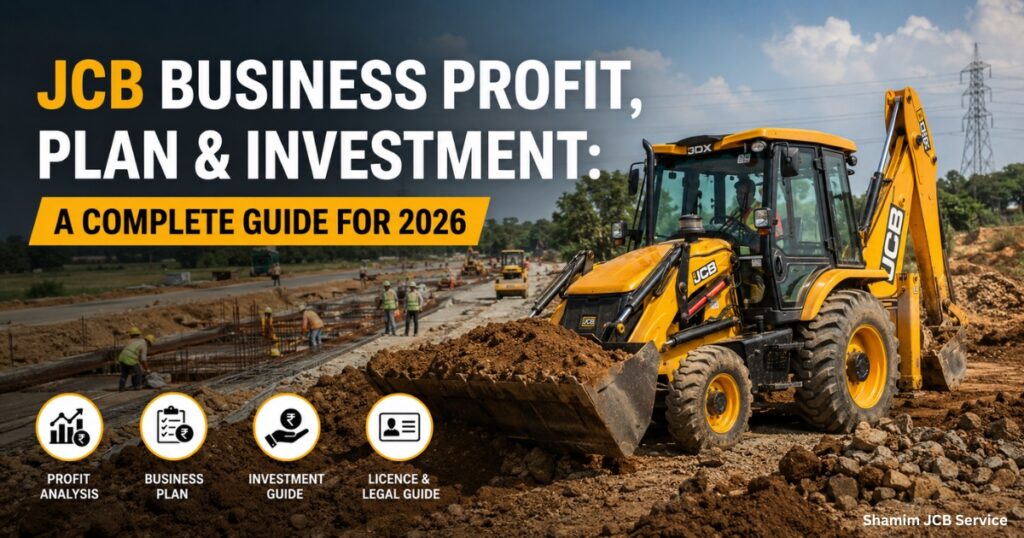
Starting a JCB business in India can be profitable, but success depends on machine utilisation, operating costs, and consistent project work. In this guide, you’ll learn about JCB business profit, investment requirements, monthly income, licensing requirements, and how to create a practical JCB business plan for 2026.
Is JCB Business Profitable in India?
The short answer is yes but like any heavy equipment business, profitability depends on how you manage utilisation, maintenance, and contracts.
A JCB backhoe loader (the classic 3DX or 3CX model most commonly seen on Indian roads) can generate between ₹25,000 and ₹60,000 per month in net income when consistently employed. That’s a wide range, and the gap between the two ends of it comes down to a few critical factors.
Purchasing of JCB requires intensive amount of capital and proper management system to run effectively based on regional demand as we already know the competition is also increasing day by day, so it always require a proper planning with its unique execution techniques.
What makes a JCB business profitable:
- High machine utilisation (ideally 22–26 working days per month)
- Contract work rather than ad-hoc daily hire
- Low fuel wastage and disciplined operator behaviour
- Timely preventive maintenance to avoid costly breakdowns
- Operating in regions with active construction, road, or irrigation projects
Teams at Shamim JCB often find that operators who build long-term relationships with contractors rather than waiting at the roadside for daily hire earn significantly more and have far greater income stability.
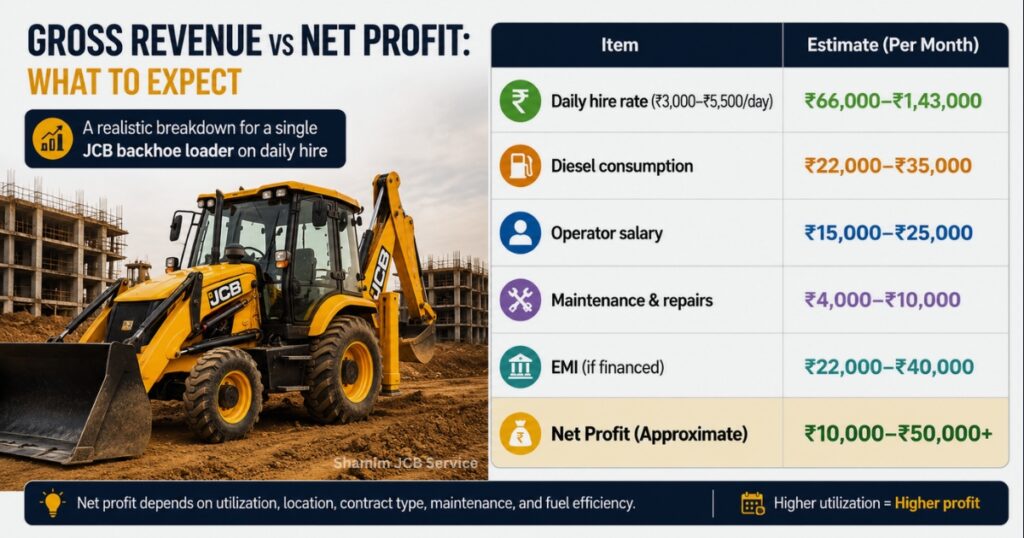
Gross Revenue vs Net Profit: What to Expect
Here’s a realistic breakdown for a single JCB backhoe loader on daily hire:
JCB Business Profit Per Month
The profit from a JCB business largely depends on machine utilisation, local hire rates, and operating costs. A machine working 20–25 days per month can generate significantly higher returns than one operating only occasionally.
- Self-Owned JCB (No Loan): Typically earns ₹45,000–₹70,000 per month after fuel, operator, and maintenance expenses.
- Financed JCB: Usually generates ₹20,000–₹40,000 per month during the loan period after EMI and operating costs.
- Contract-Based Work: Machines deployed on long-term infrastructure and construction projects can generate ₹50,000–₹1 lakh+ in monthly profit with high utilisation.
The key to higher JCB business income is keeping the machine consistently employed. Strong contractor relationships, efficient maintenance, and steady project work have a greater impact on profitability than simply charging higher daily rates.
Is Buying a JCB a Good Investment?
For entrepreneurs involved in construction, excavation, land development, or infrastructure projects, buying a JCB can be a profitable long-term investment. However, profitability depends on machine utilisation rather than ownership alone. A JCB that works 20–25 days per month can generate steady income, while an idle machine quickly becomes a liability due to maintenance, insurance, and financing costs.
Return on Investment: Quick Numbers
In 2026, a new JCB 3DX typically costs between ₹30 lakh and ₹38 lakh on-road, depending on location and specifications. With average net profits ranging from ₹30,000 to ₹70,000 per month, most owners recover their investment within 5–8 years, provided the machine maintains consistent utilisation.
A used JCB (3–7 years old) generally costs between ₹12 lakh and ₹22 lakh and can offer a faster return on investment due to the lower purchase price. Well-maintained machines with reasonable operating hours can still deliver several years of productive service, although repair and maintenance costs are usually higher than newer models.
For most buyers, a JCB investment in India makes financial sense when there is enough local demand to keep the machine working at least 18–20 days per month. The higher the utilisation rate, the faster the return on investment.
When Buying a JCB Makes Strong Business Sense
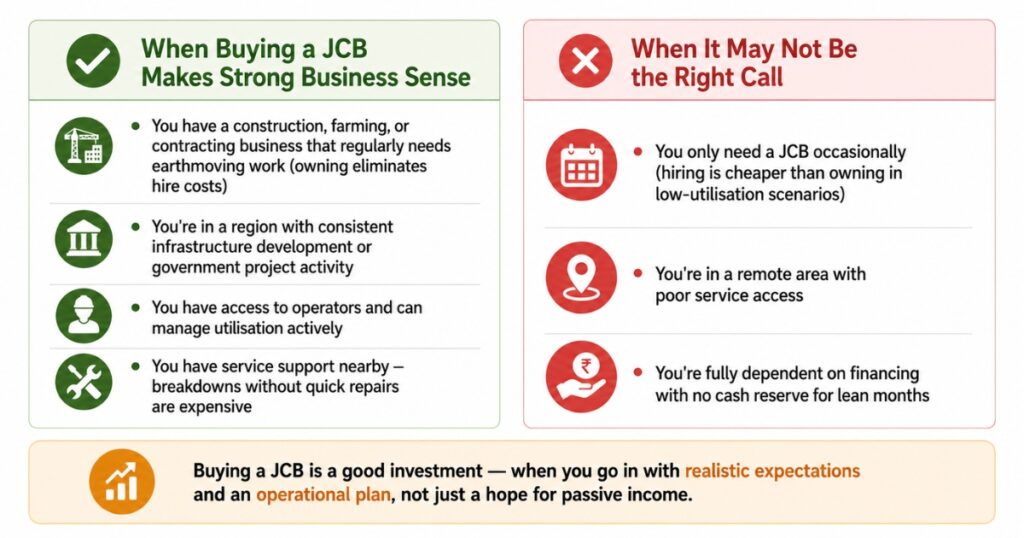
- You have a construction, farming, or contracting business that regularly needs earthmoving work (owning eliminates hire costs)
- You’re in a region with consistent infrastructure development or government project activity
- You have access to operators and can manage utilisation actively
- You have service support nearby breakdowns without quick repairs are expensive
When It May Not Be the Right Call
- You only need a JCB occasionally (hiring is cheaper than owning in low-utilisation scenarios)
- You’re in a remote area with poor service access
- You’re fully dependent on financing with no cash reserve for lean months
Buying a JCB is a good investment when you go in with realistic expectations and an operational plan, not just a hope for passive income.
JCB Business Plan: How to Structure Your Operation
A successful JCB business plan focuses on three things: machine utilisation, operating costs, and a steady flow of work.
Choose a Revenue Model
Most JCB owners earn through:
- Daily Hire: Charging a fixed daily rate for excavation, land levelling, foundation digging, and site preparation work.
- Contract Work: Working on road construction, land development, drainage, and infrastructure projects with agreed project rates.
- Own-Use + Hire: Using the machine for your own construction or agricultural work and hiring it out when available
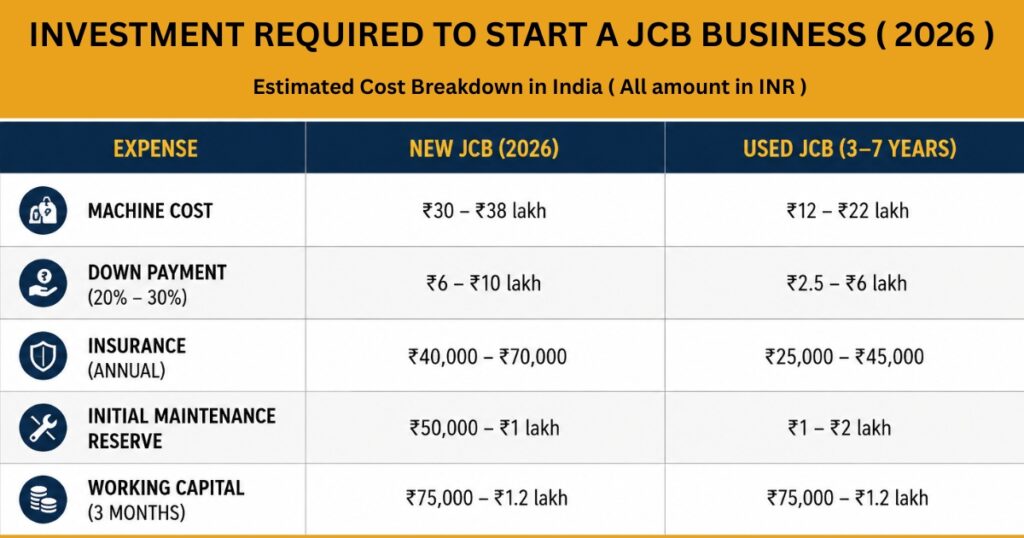
Understand Your Break-Even Point
A financed JCB typically needs around 15–18 working days per month to cover EMI, fuel, operator wages, and maintenance expenses. Higher utilisation directly improves profitability.
Secure Work Before Buying
Before purchasing a machine, assess local demand, connect with contractors and builders, and understand prevailing hire rates in your area. Having potential clients lined up before investing significantly reduces business risk.
Which Licence Is Required for JCB in India?
A JCB backhoe loader is classified as a Construction Equipment Vehicle (CEV) in India. If the machine is driven on public roads, the operator typically requires a valid Heavy Motor Vehicle (HMV) licence issued by the Regional Transport Office (RTO).
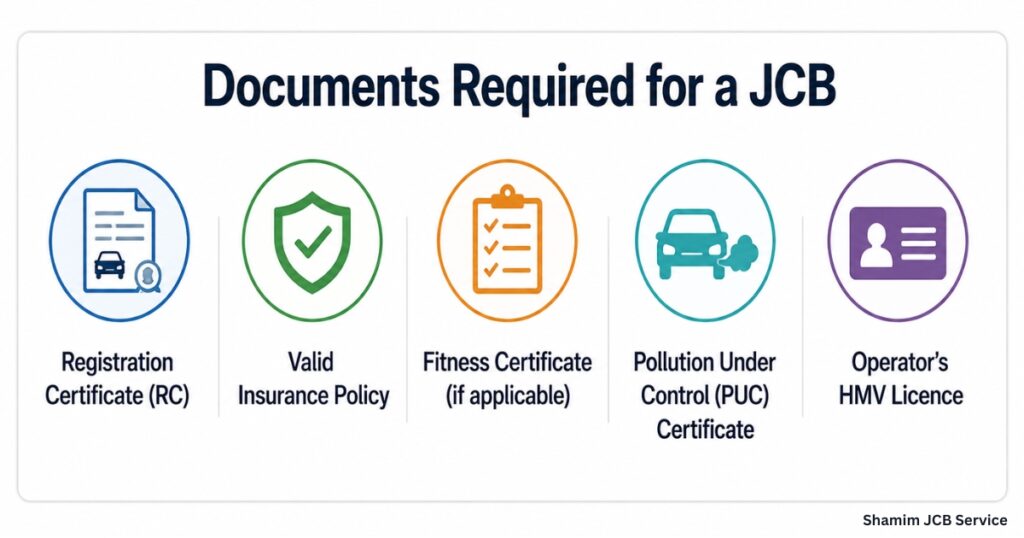
Documents Required for a JCB
To operate a JCB legally, the following documents are generally required:
- Registration Certificate (RC)
- Valid Insurance Policy
- Fitness Certificate (if applicable)
- Pollution Under Control (PUC) Certificate
- Operator’s HMV Licence
Do You Need a Contractor Licence?
A contractor licence is not required to own or operate a JCB. However, businesses bidding for government construction, road, irrigation, or infrastructure projects may need contractor registration with the relevant department or authority.
Before purchasing a machine, it is advisable to verify the latest licensing and registration requirements with your local RTO, as regulations may vary by state.
JCB Business Demand in India
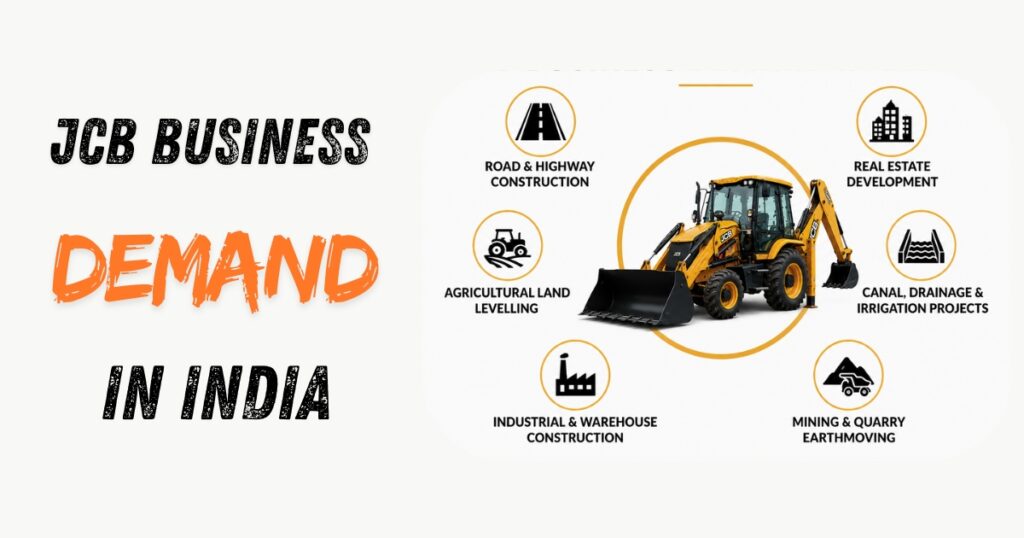
Demand for JCB machines is closely linked to construction, infrastructure, mining, and land development activities. Areas with ongoing road construction, housing projects, industrial development, and agricultural land levelling typically generate the highest demand for earthmoving equipment.
Some of the major sectors driving JCB business opportunities include:
- Road and highway construction projects
- Residential and commercial real estate development
- Agricultural land levelling and excavation work
- Canal, drainage, and irrigation projects
- Industrial and warehouse construction
- Mining and quarry-related earthmoving
Before investing in a JCB, evaluate local construction activity, contractor demand, and upcoming infrastructure projects in your area. Markets with consistent project activity generally provide better machine utilisation and more stable income throughout the year.
Conclusion
Starting a JCB business can be a profitable opportunity when supported by consistent work, proper cost management, and high machine utilisation. Whether you’re considering your first machine or evaluating the earning potential of the earthmoving industry, success ultimately depends on keeping the equipment productive and maintaining a steady pipeline of projects.
Understanding investment costs, operating expenses, licensing requirements, and local demand can help you make more informed decisions before entering the business.
At Shamim JCB Service, we provide professional JCB excavation and earthmoving services for construction, land levelling, foundation digging, site clearing, trenching, and related projects. With experience handling a variety of excavation requirements, we understand the practical challenges involved in earthmoving and construction work.