
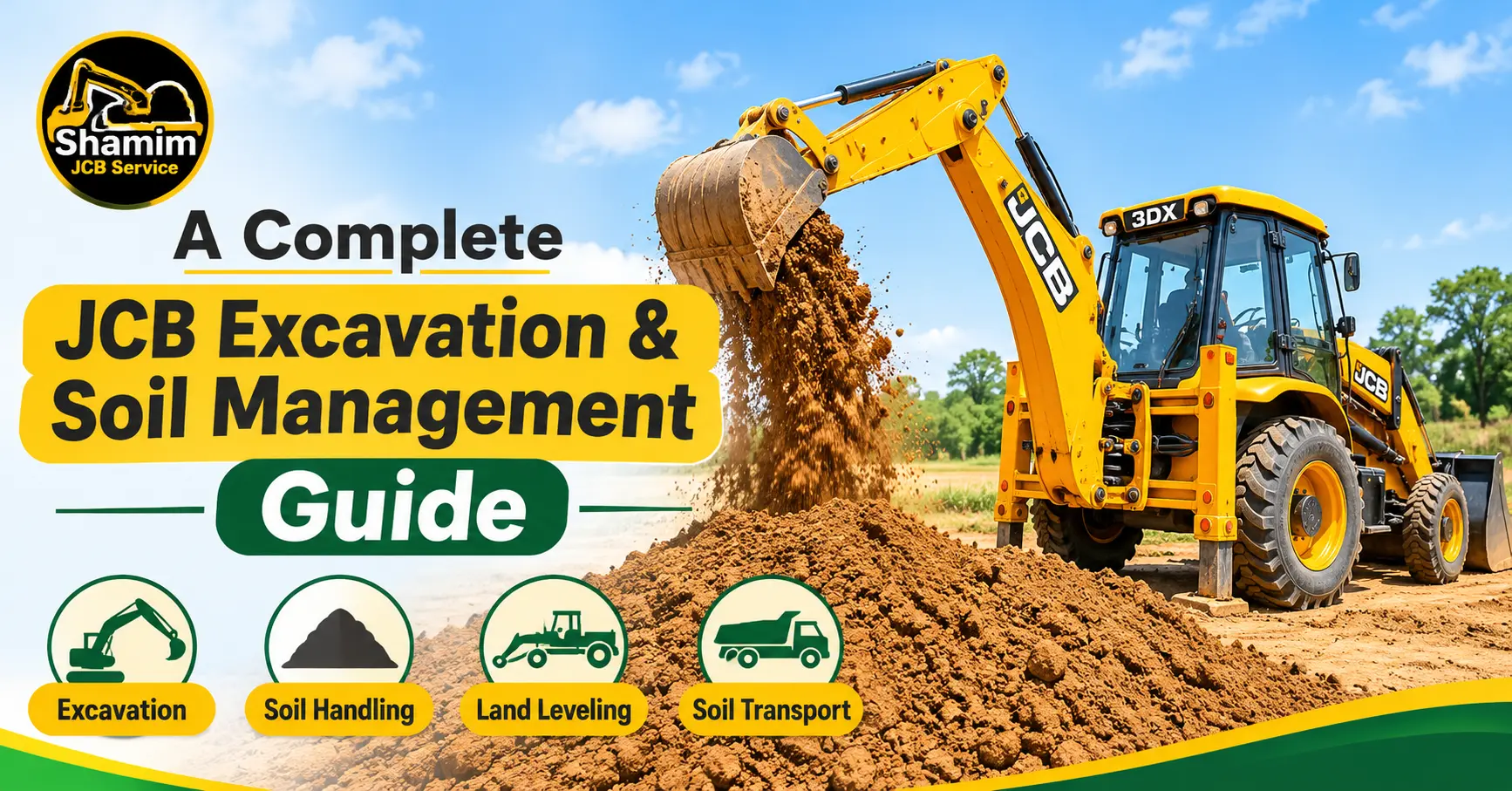
What is the finest approach to dig a pond (talab) in Kochadhaman, Bihar? The best option is big machinery such as JCB backhoe loaders or excavators with tractor-trolley soil transfer.
Mechanical excavation can reduce project timescales from weeks to 1–3 days, with accurate depth control (6–10 feet for fisheries), ideal side-bank slopes and immediate soil transportation for land filling or embankment (pind/bandh) building.
For competent local execution, Shamim JCB Services (+91 7033027991) provides full-service earthmoving, pond digging and soil management in Kochadhaman, Dogharia, Purandaha and Kishanganj.
What is Pond Excavation and Why Pond Excavation is needed in Kochadhaman?
Pond excavation or talab digging is the practice of excavating dirt from a specified area to construct a regulated water reservoir for fish breeding (aquaculture), agricultural irrigation, supply water for livestock or rainwater collection. Pond digging in low lying agricultural areas like Kochadhaman and Kishanganj, will enable the land owners to conserve water all year round and earn income by growing fish (such as Rohu, Catla and Tilapia).
In addition to the water retention aspect, pond excavation produces large quantities of fertile topsoil and clay-rich subsoil. Small company owners and landowners often use excavated soil to fill in low-lying plots, build raised home foundations or raise road levels, giving a dual-benefit earthwork solution from a single excavation effort.
Why Use JCB Heavy Machinery Instead Of Manual Digging?
While traditional manual labor was once common for small ditches, modern commercial and agricultural ponds require structural integrity, depth control, and rapid execution that manual labor cannot deliver. Utilizing JCB earthmoving equipment provides clear operational advantages:
- Unmatched Speed & Efficiency: Unmatched Speed & Efficiency One JCB excavator can do the work of several weeks of physical labor in 1 to 3 days, with the capacity to move hundreds of cubic feet of soil every hour.
- Consistent Depth & Slope Precision: Fish ponds require flat bottoms and sloped bank walls (usually a 2:1 slope ratio) to minimize soil erosion and water leakage. JCB machines deliver a consistent grade across the whole pond bed.
- Seamless Soil Loading & Management: JCB backhoe loaders can dig the ground and dump it directly onto tractor-trolleys for quick moving, thus minimizing double handling expenses.
- Cost-Effectiveness for Large Projects: Renting machines by the hour is cheaper than paying daily wages for manual labor over longer periods. It greatly reduces the total cost per cubic foot of earth dug out.
How Do You Plan a Successful Pond Excavation Project in 5 Steps?
Step 1: Conduct Site Inspection and Soil Quality Assessment
Before you bring in heavy gear to your land in Kochadhaman, verify that the site has good hydrological and soil qualities.
- Soil Water Retention: Clay or clay-loam soil is best since it seals in and retains water naturally. The heavy sandy soils drain water away quickly and may need artificial lining or layers of imported clay.
- Natural Topography: Placing ponds in natural low-lying catchments requires less digging volume as natural surface runoff during the rainy season is utilized.
- Machinery Access: Provide easy and stable access (minimum 10-12 feet wide) for JCBs and tractor-trolleys to enter and exit without becoming bogged down in soft terrain.
Step 2: Determine Specific Pond Dimensions and Depth Guidelines
- Fish Farming (Fisheries Ponds): Target a standard depth of 6 to 10 feet (1.8 to 3 meters). Deeper water prevents rapid temperature fluctuations, protecting fish stock during peak summer months.
- Agricultural & Rainwater Harvesting Ponds: Depths of 8 to 12 feet with wider surface areas are recommended to maximize storage volume for crop irrigation during dry seasons.
Step 3: Execute Excavation and Soil Management Strategies
Pond excavation generates substantial soil volume. A well-planned project utilizes this soil efficiently through two primary methods:
- Embankment Construction (Bandh/Pind): The dug soil should be dumped along the boundary of the pond to raise the dikes all around the circumference. The compaction of the machines ensures that these embankments do not erode and overflow in case of floods during the monsoon seasons.
- Off-Site Transportation & Land Filling: Load excess soil onto tractors to fill nearby low-lying agricultural land, level commercial sites, or supply housing foundation projects in Kishanganj district.
Step 4: Slope Stabilization and Bank Compaction
Shape sides down into gradual slopes so that there is not a bank collapse but a gradual slope down. Heavy JCB bucket packing along the bank margins hardens the soil surface and reduces future erosion by wave action.
Step 5: Final Grading and Water Inlet/Outlet Setup
Install regulated inlets and overflow spillways with wire mesh screens to help maintain water levels and prevent native fish from fleeing or wild fish accessing your pond.
What are the Factors that Influence the Cost of JCB Pond Excavation in Kochadhaman?
The entire cost to dig a pond relies upon the equipment rates, the size of the project, and the particular site conditions. The key cost drivers are as follows:
- Machine Operating Hours: JCB services near Kochadhaman usually charge on hourly operating rates. The larger the pond ( needing substantial digging ), the more overall machine hours.
- Soil Density and Moisture: Dry, packed clay moves quickly, whereas swampy, waterlogged, or rocky ground slows machine cycle times, slightly increasing overall operational hours.
- Tractor Transport & Hauling Distances: When the soil is carried to secondary sites further afield, the total project budget increases with more tractor-trolley trips and diesel costs.
Conclusion
Kochadhaman Pond excavation or talab digging needs good planning, right machinery and correct soil management for optimal outcomes. Whether you’re building a fish farm pond, installing an agricultural water storage system or reclaiming low-lying ground, JCB equipment can make the excavation process faster and easier. Every stage, from choosing the proper pond depth, shaping the embankments, loading extra soil to tractor-trolleys and coordinating land filling, plays a significant role in a successful project.
If you are preparing for JCB pond digging in Kochadhaman, then you can coordinate machinery, excavation and dirt transfer according to your site requirements by picking an experienced local earthmoving firm. Shamim JCB Services is prepared to give JCB pond excavation, soil cutting, loading and earthmoving support in Kochadhaman, Dogharia, Purandaha and adjacent areas of Kishanganj.
Frequently Asked Questions (FAQ’s)
This depends on the soil conditions, weather and number of tractor-trolleys utilized for removing soil. But on an average, a regular 1 acre fish pond (6-8 feet depth) requires between 2 to 4 days of JCB operation time..
For sure. In Kochadhaman and Kishanganj, the soil from excavations is a prized commodity, used for filling low-lying plots, raising the height of foundations for new homes or making agricultural bunds. You can cover the cost of your excavation by selling extra soil.
Best time is the dry winter and summer months (Nov-May). Dry ground lets heavy machinery move around without becoming caught in mud, speeding up execution before the monsoon rains.
Generally, there are not many formalities in setting up personal agricultural ponds on private land. But one has to register with the local fisheries department in Kishanganj before asking for government subsidies (e.g. fishing schemes under PMMSY).
Contact local earthmoving professionals like Shamim JCB Services for site assessment, machine hour estimation, and logistical coordination for both equipment and tractor.